Tecnologie per la purificazione dell'acqua
Se abbinate fra loro, le tecnologie impiegate nell'apparecchiatura ELGA sono in grado di eliminare le impurità dall'acqua fino a livelli estremamente bassi. Alcune tecnologie si concentrano su contaminanti specifici, mentre altre possiedono un più ampio spettro di destinazione. Al fine di ottenere il livello di purezza dell'acqua corretto per una determinata applicazione, in modo meno oneroso, le tecnologie devono essere abbinate e il loro funzionamento dev'essere ottimizzato.
In questa pagine potrai scoprire maggiori informazioni sulle tecnologie utilizzate in abbinamento per l'eliminazione delle varie impurità presenti nelle forniture di acqua potabile.

Water purifier technology: Frequently asked questions
- How does reverse osmosis work?
Reverse osmosis (RO) pushes water through a semi-permeable membrane under pressure. The membrane rejects roughly 95–99% of dissolved salts, along with larger organic molecules, particulates, bacteria and pyrogens, while purified water passes through. RO is typically used as a bulk or primary stage, followed by polishing to achieve ultrapure (Type I) water.
- What is the difference between reverse osmosis and deionization (RO vs. deionization)?
RO uses a membrane to remove a broad range of impurities — ions, organics, microbes and particulates — to a moderate level. Deionization (ion exchange) uses resins to target dissolved ions specifically and can reach Type I resistivity (up to 18.2 MΩ·cm). They are complementary: RO does the bulk removal, and deionization polishes the water to ultrapure. RO does not remove all ions on its own, and deionization does not remove non-ionized organics, particles or bacteria.
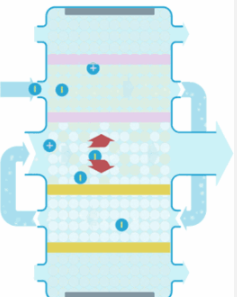
- How does electrodeionization (EDI) work?
EDI combines ion-exchange resins, ion-selective membranes and a direct electric current to remove dissolved ions continuously. The electric current also regenerates the resin electrochemically, so EDI runs without the chemical regeneration required by conventional deionization. It is usually placed after RO to deliver consistent Type II water.
- Which water purifier technology should I use?
It depends on the water type you need (Type I, II or III), your feed water quality, your application and cost. In practice, technologies are combined — for example RO followed by EDI and/or ion exchange, with UV and final filtration — to reach the required purity reliably and cost-effectively. View our Laboratory Planning page for more information to help you find the best technology for you.
- What is ultrapure (Type I) water?
Ultrapure (Type I) water is the highest laboratory grade, with resistivity up to 18.2 MΩ·cm at 25°C and very low levels of ions, organics (TOC), particulates and bacteria. It is produced by combining technologies — typically RO or EDI for primary purification followed by ion exchange, UV and ultrafiltration polishing.
How each technology maps to the PURELAB purification stages
| Purification stage | Technologies used | Purpose | Suggested PURELAB product link(s)* |
|---|---|---|---|
| Pre-treatment | Activated carbon, reverse osmosis (± softening) | Bulk removal of chlorine, organics, particulates and the majority of dissolved ions to protect downstream stages. | |
| Primary purification | Reverse osmosis / EDI | Produces Type II/III water and feeds the system reservoir. | |
| Polishing | Ion exchange (DI) + UV (185/254 nm) + PureSure® | Removes residual ions and organics to deliver ultrapure Type I water, with PureSure® monitoring for consistency. | |
| Point-of-dispense | Sub-micron / ultrafiltration | Final removal of particles, bacteria and pyrogens at the point of use. |